
Joy Should Not Seem So Revolutionary
The Power of Historical Romance to Imagine Resilient and Radical Happy Endings in the Face of Oppression
by Jane Hadley
Like many living in the United States, I’ve been having a little bit of a hard time believing in happy endings.
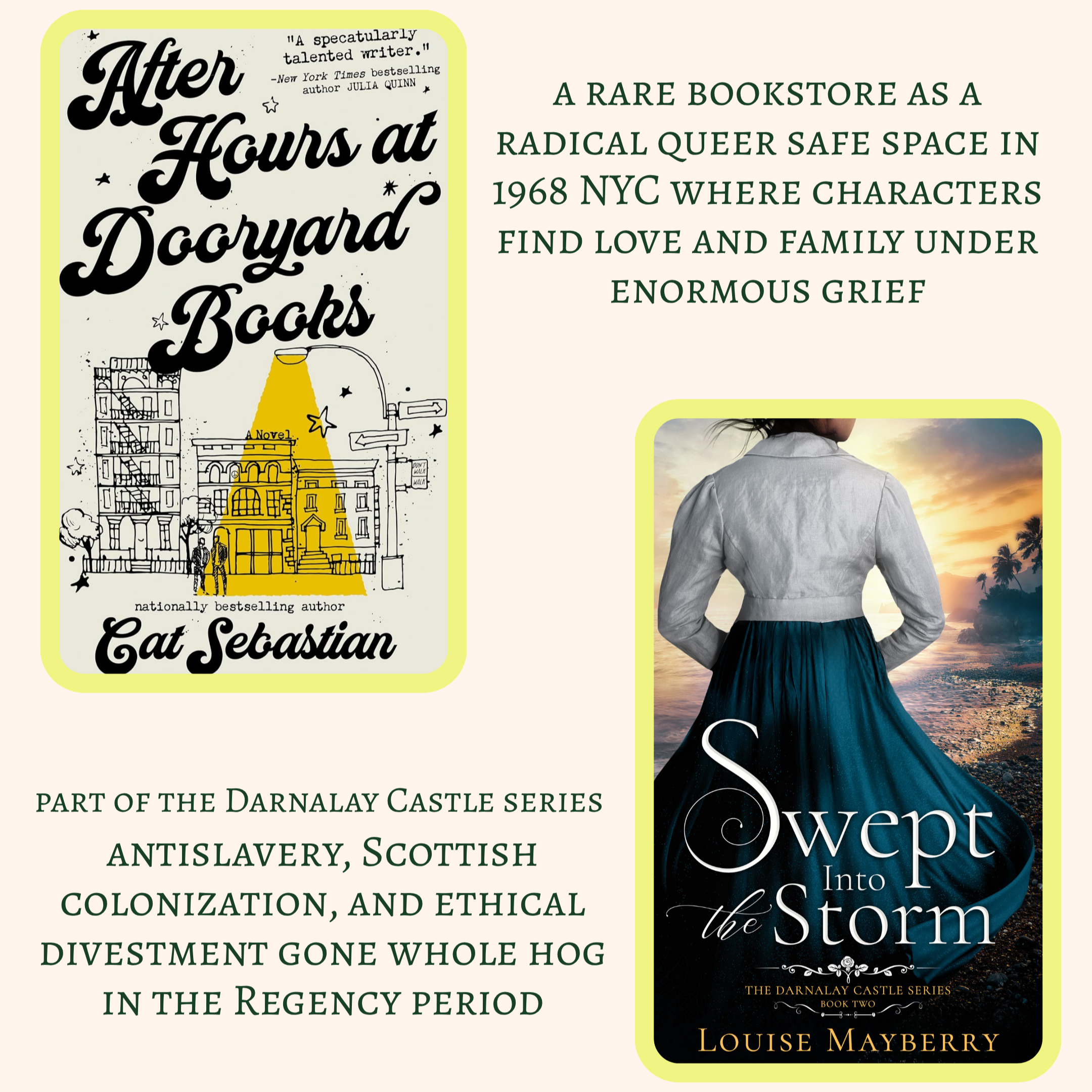
Recently, I read After Hours at Dooryard Books by one of my favorite histrom writers, Cat Sebastian. It’s a MM historical romance set in Greenwich Village in 1968. This was a turbulent year to be sure, and I went into the book noting the content warnings and trusting the author to take care of me. See, I needed to read something that acknowledged living in a turbulent reality. I was living through one.
I read Dooryard Books in January of this year, as my Twin Cities community was under the occupation of Operation Metro Surge. It was the way I turned off my brain each night before bed, worrying about whether I should turn my phone off when I drove my daughter’s classmate to school (if I got pulled over, would they be able to locate his mother using my phone?). My sister was too afraid to come to my book release because ICE had been at her place of work that day right before they shot Renee Good. Not two weeks later, my family bundled up in subzero temperatures to hold vigil on the streets of St. Paul for Alex Pretti. I was organizing fundraisers and listening to Minnesota Public Radio and checking Signal chats until I could feel my throat literally choking me with fear. A few days after they announced a draw-down, I saw an ICE agent with Ramsey County Sheriff officers right in front of my children’s school. I needed—I needed—a safe place to escape, just long enough to fall asleep.
But it couldn’t be just any book. I couldn’t focus on something light or cozy when my entire nervous system was sounding an urgent alarm. I had no interest in alternate realities. I desperately needed to feel seen, to read something that understood the grief and the fear and the outrage. I didn’t want to numb it away. It was real and it was important and it deserved to be acknowledged. Dooryard Books let me cry on its shoulder. Reading it was a comfort, not because it was an escape from the tyranny I was witnessing, but because it told a story about a time that echoed my own.
1968 was a volatile year. Martin Luther King and Robert Kennedy were both assassinated that year. Protests against the war in Vietnam were ramping up, and the Civil Rights Movement was pushing to confront deep sources of structural racism in jobs, housing, and poverty. Reading about characters experiencing their volatile time with the same kind of existential dread that I felt, while also finding themselves and love and belonging in a community of safety—the promise of the HEA that forms the romance genre—this was important to read. It hurt, at times, but it was important.
“Dooryard Books let me cry on its shoulder. Reading it was a comfort, not because it was an escape from the tyranny I was witnessing, but because it told a story about a time that echoed my own.”
Instead of escaping away, I needed to be in conversation with a story that understood. All fiction contends with its time in some way, but I have been emotionally damaged by reckless litfic too many times. Scifi and fantasy were too far removed, and mystery was way too murdery for my tender soul. Nonfiction was right out—the reality of each day was too activating already. Historical romance presented a unique convergence of lives that felt real, struggle against oppression that echoes our own, and the power of love as an antidote to despair. I think historical romance has the potential to imagine radically happy endings set in real-life struggle. It can play back the historical echoes of our own time. It can help us feel seen and feel hope.
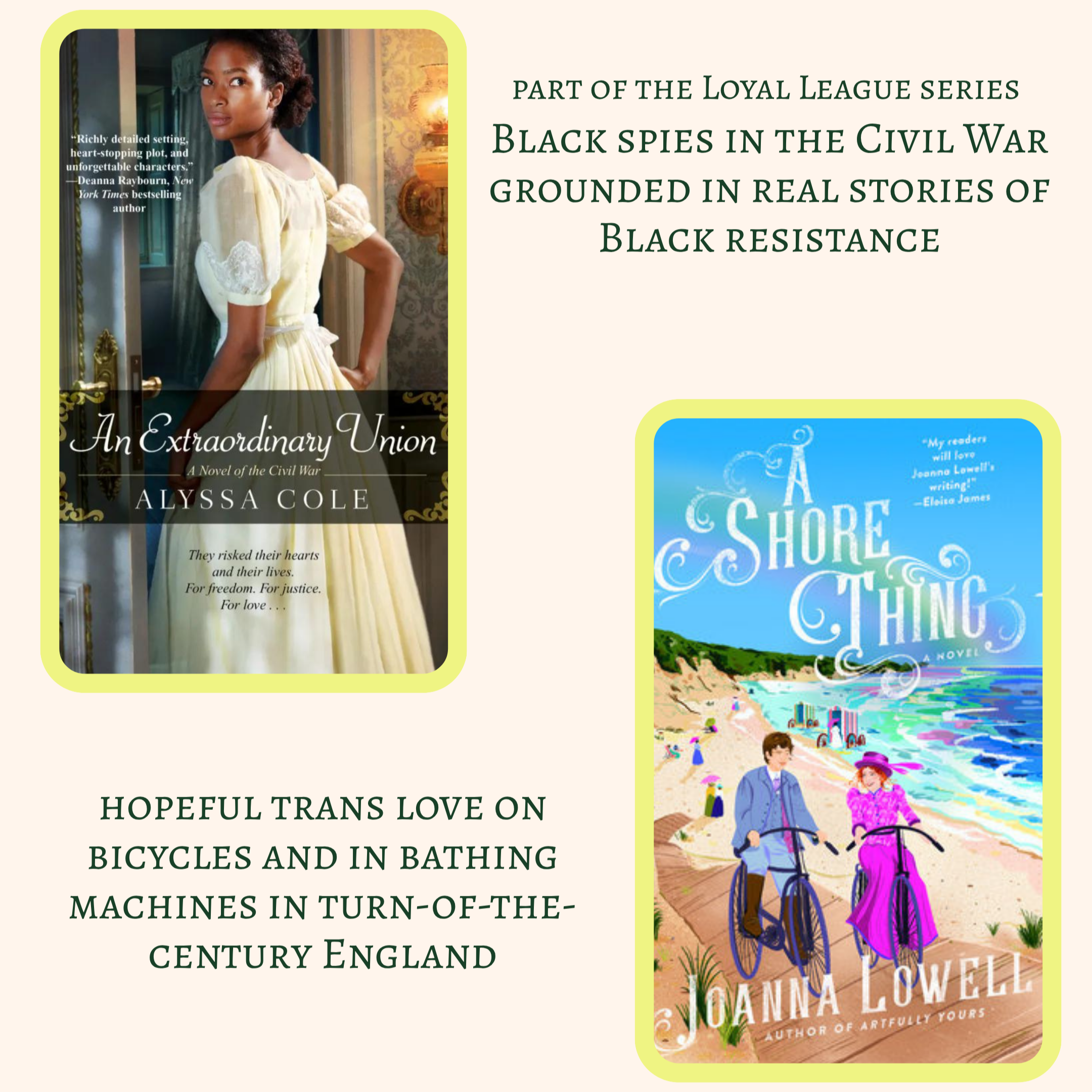
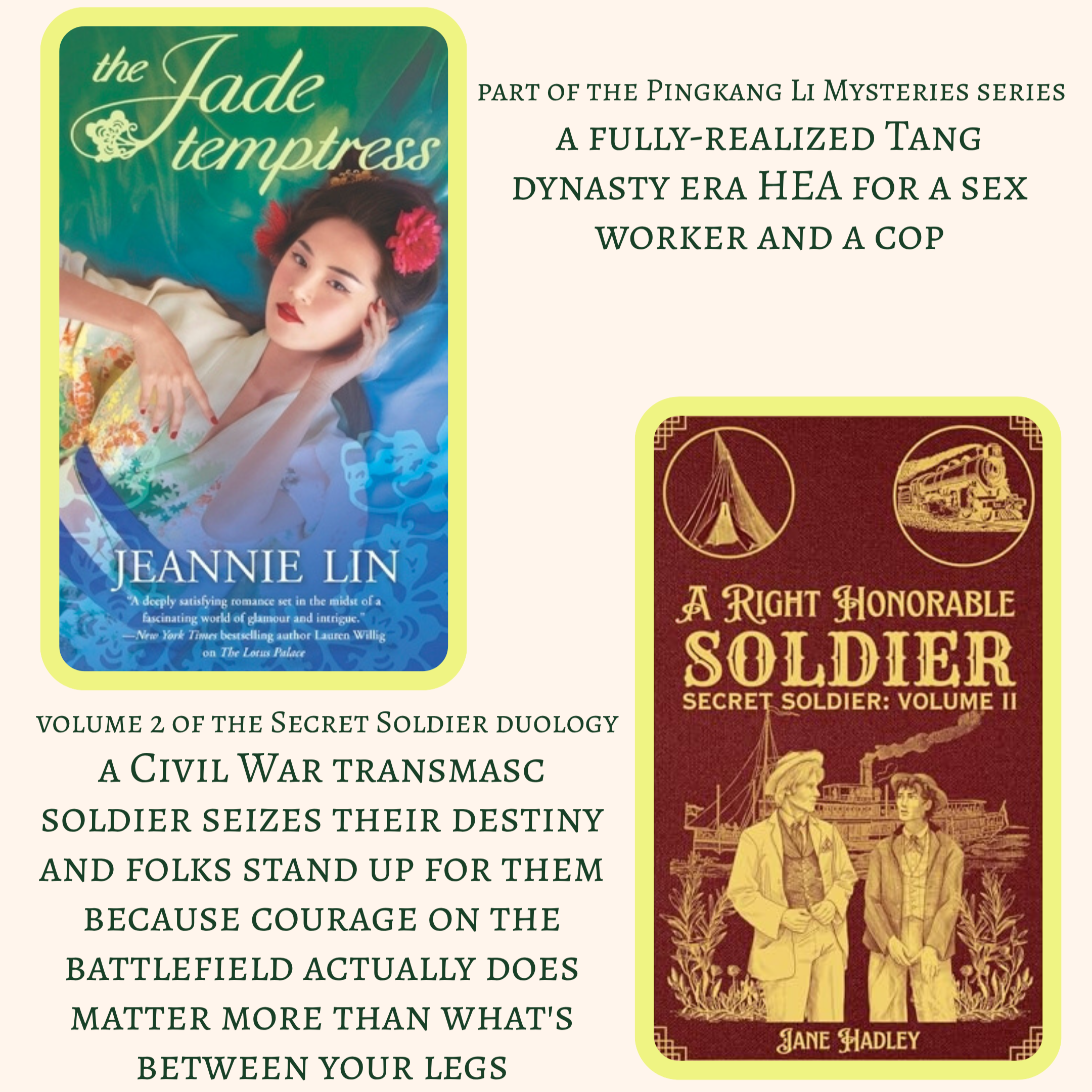
To be clear, the genre doesn’t automatically do this. It’s perfectly possible (easy, in fact) to find historical romances that are anachronistic, white-washed, idealized, or otherwise in compliance with the status quo. But when you read books like Alyssa Cole’s Loyal League series or KJ Charles’ Society of Gentlemen series, you can see clearly what resistance and resilience can look like, the kinds of courageous choices that can be made, and the ways persistence can be sustained in a world without magic or extraordinary technology. As spec fiction can show us our reflection in an imagined alternate reality, historical fiction can show us our reflection in the imagined realities of our ancestors, who faced similar problems as we do, or who experienced the roots of the issues we face now. And powerfully, as genre romance, these stories by their very nature show us hopeful endings.
“I think historical romance has the potential to imagine radically happy endings set in real-life struggle. It can play back the historical echoes of our own time. It can help us feel seen and feel hope.”
Of course, there are many obstacles standing in the way of historical romance realizing its potential in this particular quarter. Recently, the new season of Bridgerton was announced featuring a queer couple. And the people of the Internet, in their imminent wisdom, went wild debating whether or not this was “historically accurate.”
Sigh.
I presume that the students of Romancelandia University didn’t buy into that hysteria for a second, and that we have no need to delve into the myriad of ways this assertion is nonsense. I am left to wonder what this says about our cynicism in the present-day that we can’t believe a happy ending is even possible for queer people in a historical setting.
Joy should not be so revolutionary. Not in the stories we tell each other about our past, and certainly not in our present.
I want to read stories not about historical accuracy, but historical contingency. People in the past, just like today, made choices based on what they understood was true and right and possible. We do that too. I want to read stories that get me thinking about what choices are possible.
In Dooryard Books (without giving too much away), one of the main characters reaches a breaking point in his career and quits. There are serious consequences to quitting, and he suffers a great deal for it. But he makes the choice to stand in his values rather than continue to comply with tyranny.
The radicals, the eccentrics, the outcasts, and the innovators made choices that pushed against the status quo. If we didn’t have them, we wouldn’t have germ theory or voting rights or marriage equality or a hundred other examples. One of the most encouraging things about studying history is learning about the stories of people who resisted. Even if they didn’t win, their stories are remarkably invigorating.
Take my friend Louise Mayberry’s book, Swept by the Storm. It’s a romance between an unlikely Scottish lord and a mixed Scottish Indigenous abolitionist from the Yucatan who has got no damn time for this charming, shipwrecked ding dong. This book does an incredible job of pushing hard against the status quo, both in terms of the historical setting and in terms of the reader’s expectation of what can constitute a happy ending for these characters. There was a point where I checked the page count and thought, “Oh no, there’s no way, there’s no way they can find a way to be together!!!” But they did. No spoilers, obviously, but the way Mayberry pushed beyond the usual “ethical aristocrat” tropes we’ve come to accept so we can suspend our disbelief long enough to pretend all these Dukes don’t have their fortunes wrapped up in the slave trade—it was great. I left that book with a new understanding of what real divestment of economic inequality could actually look like in her setting of the 1820s. It made me think about ways we could divest from similarly problematic business models today. Participation in amoral markets is a choice, then and now.
“One of the most encouraging things about studying history is learning about the stories of people who resisted. Even if they didn’t win, their stories are remarkably invigorating.”
I hope we're beginning to realize that our historical superiority is a little misplaced. Heinous inequality plagues our world. We struggle to see beyond our own culture in our own time. Take Bridgerton again. It imagines an alternate timeline of radical racial equality. But women are still traded for status and their greatest prize is their virginity. And everyone treats this as inevitable. “That's just how it was back then.” Even as things get increasingly more terrifying, we cling to this notion that we are still better off than people in the past. “We've lost bodily autonomy, but at least we don't have to marry for money on the marriage mart.” What if Progress was a lie? What if the people of the past weren't ignorant fools, but in fact just as flawed and earnest and filled with longing as we are? What if our own future isn't inevitable at all? What if we can choose to steer it in a different direction?
“What if the people of the past weren’t ignorant fools, but in fact just as flawed and earnest and filled with longing as we are?”
What if we leveraged our readership and attention toward, not escapism, but radical joy? Instead of numbing our fears about the present, what if we soothed them with stories that imagine resilient happy endings for people who have experienced similar challenging times? After all, joy isn’t the reward for overthrowing oppression once and for all. It is the fuel that drives resistance. It’s the network of beautifully human connections that are built when we all lock arms and stand up against tyranny. And If I've learned anything living in Minnesota in 2026, it's that we're allowed to experience joy while still demanding better.
Joy Shouldn’t Be So Revolutionary reads for your RU syllabus: